Compliant Product Carbon Footprints at portfolio scale, straight from a Bill of Materials
Micha Schildmann, Melina Hürzeler
|
July 21, 2026

Micha Schildmann, Melina Hürzeler
|
July 21, 2026
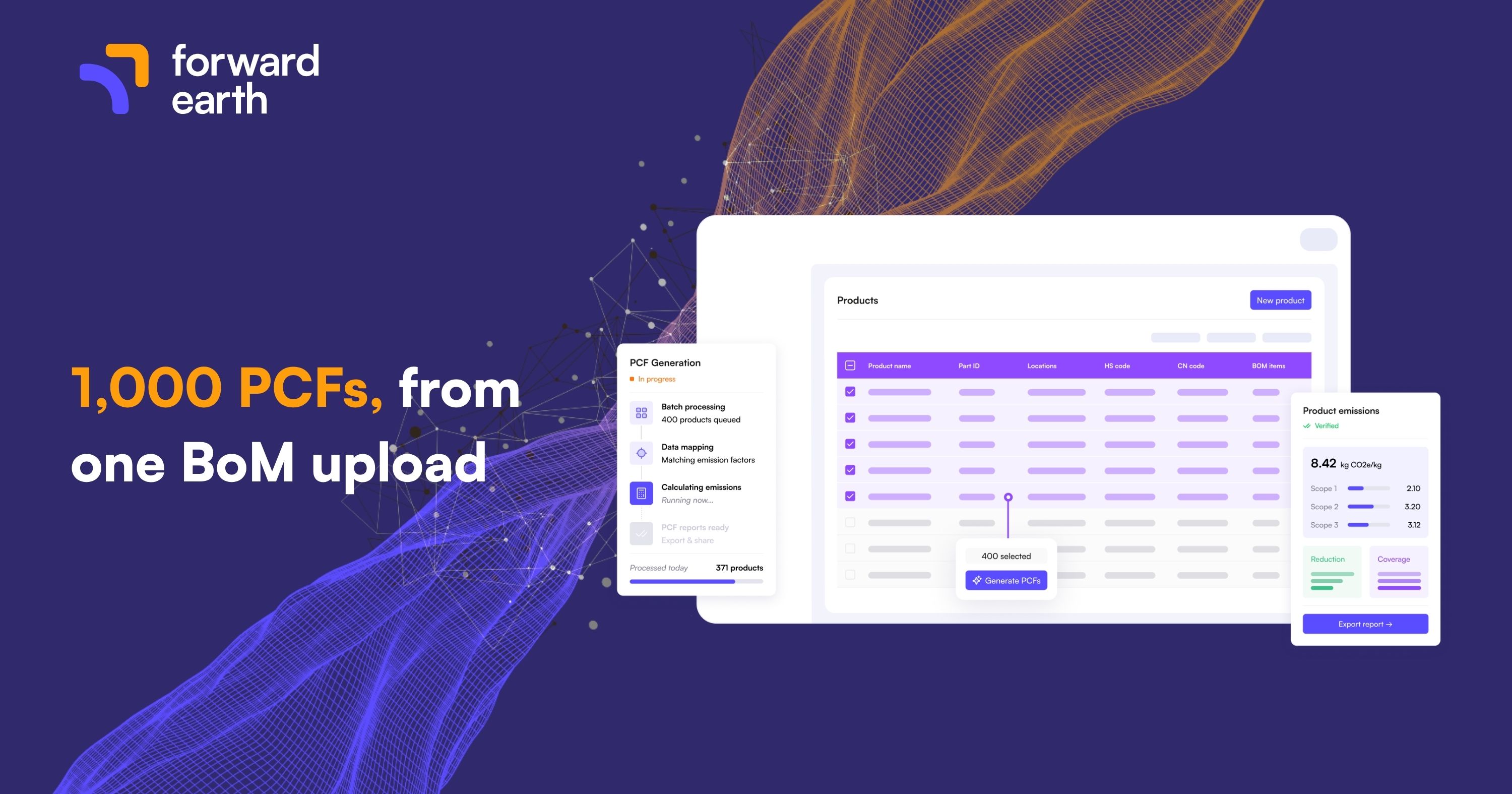
Compliant PCFs for a whole portfolio straight from a Bill of Materials (BoM), with no separate manual LCA per product.
Our AI estimates data gaps and matches emission factors, but every value is labelled and auditable, so you can defend or adjust the number.
Results are compliant with ISO 14067, PACT v3.0, and the GHG Protocol Product Standard.
A company-level footprint is no longer enough. Major buyers, automotive and electronics OEMs, and regulators now ask for product-level emissions as a condition of doing business, and several pessures have landed at once.
At forward earth, we help you bridge that gap. Whether you are a direct manufacturer managing your own portfolio or a software vendor embedding our white-label solution to support your clients, the path forward combines traditional rigour with the scale of AI-assisted automation. You do not need perfect data to start; you need a structured workflow that turns your existing Bill of Materials (BoM) into actionable, compliant footprints. And because our platform is available via MCP (Model Context Protocol), your own AI agent can work with your PCF data directly. In the sections below, we outline how to move from messy, non-standard ERP data to verifiable, portfolio-scale PCFs without losing months to manual consulting.
Traditional LCA is rigorous but slow. AI PCF tools are fast but rarely show their work. We give you both. Our approach brings a compliant calculation to the BoM you already have, so you get portfolio-scale throughput and results you can review.
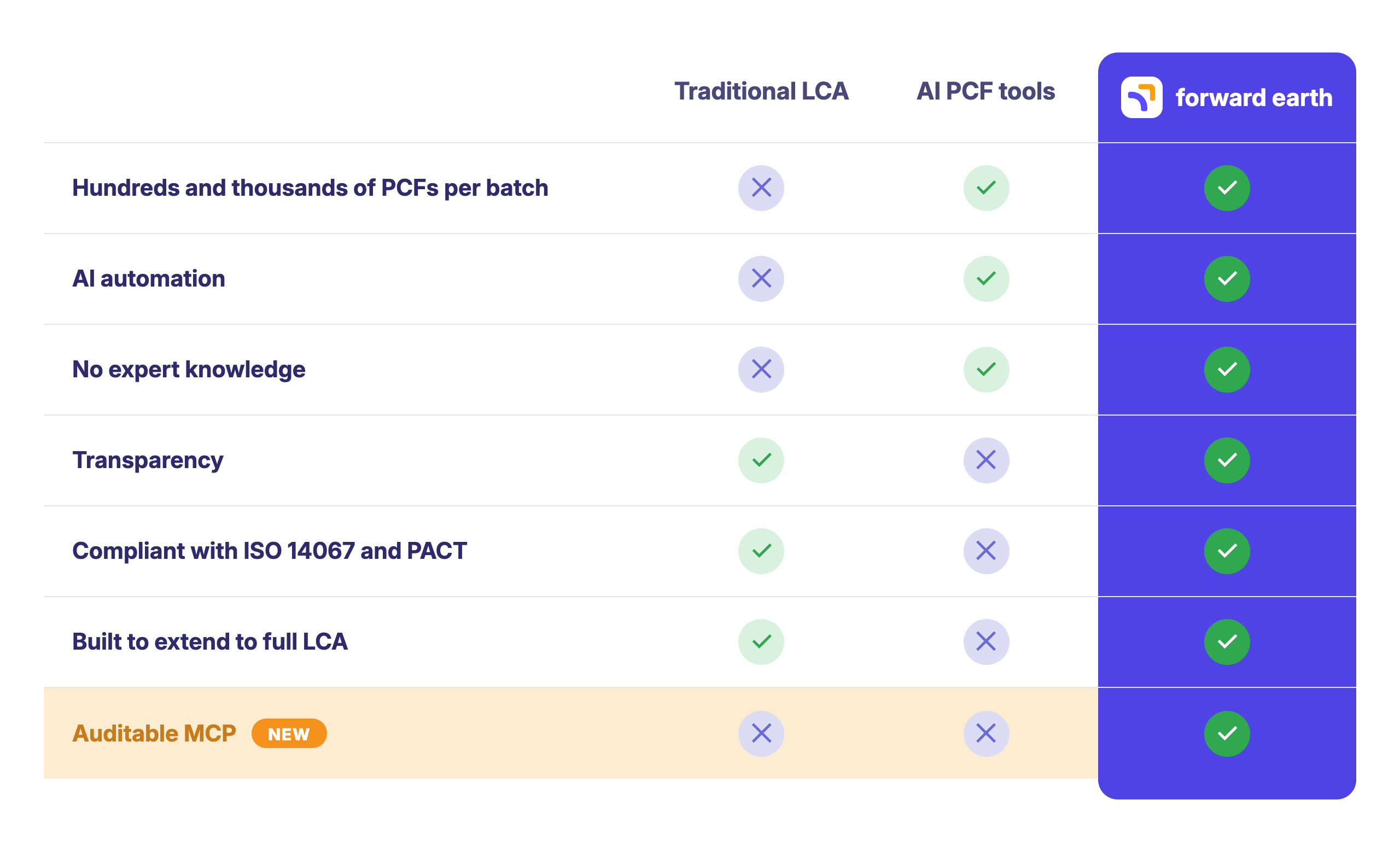
Instead of opaque guesses, our software highlights the data gaps, estimates missing values with a confidence score, and explains the reasoning behind every emission-factor match, keeping your team in control. The first result comes back in about two minutes, and a full batch of up to 1,000 products is calculated in less than two hours. Speed here comes from preparation and review, not a shortcut around them. The result is carbon data you can trust and act on.
Most manufacturers assume they cannot begin because their BoM data is incomplete, unformatted, or missing weights and material specifications. Traditional life-cycle assessments demand exhaustive, perfect data before any calculation starts, which is what creates months of delay. We take a different approach: start with the structured data you already have, even if it is messy, and improve data quality over time. Our BoM-native workflow ingests up to 1,000 products per batch, or up to 500,000 BoM rows per file, in ERP exports and non-standard spreadsheets, so you skip the reformatting.
What you need to start:
Where the data is thin, AI-assisted enrichment fills the gaps you would otherwise chase by hand. Real BoMs arrive with missing weights, blank energy fields, and inconsistent units. Rather than stopping, the engine estimates the missing values, attaches a confidence rating to each, shows the reasoning, and returns them for review, so you start from the BoM you have and know exactly where to invest in better data.
By accepting imperfect data as the starting baseline, we bridge traditional LCA precision and practical speed, and help sustainability, procurement, and operations teams find the data gaps that matter most. The goal at this stage is not a flawless dataset. It is a first footprint and a clear map of what to improve.
To calculate an accurate footprint, every material and component in your BoM must map to an emission factor. Doing that by hand across thousands of lines is slow, and typical AI software hides how it was done. Our semantic models read raw material descriptions and weights straight from the BoM and match each line to an emission factor from its source database, with a clear reasoning path instead of an unexplained percentage.
Because every value is labelled, estimated or measured, you can see exactly which numbers to trust and which to improve, and refine over time.
Before any carbon data is calculated, you set the operational boundaries of the assessment. A standards-aligned Product Carbon Footprint has to reflect the specific facilities, energy sources, and processes used in production, not generic averages. Under ISO 14067 and the PACT Pathfinder framework, these parameters determine how material inputs, upstream transport, and manufacturing energy are allocated to each product in your portfolio.
At forward earth, you can set these at the portfolio level or tune them for individual high-impact product lines, so the calculation reflects your real operations without deep LCA expertise. For partners embedding our white-label solution, the same parameters can be set through our MCP, so an AI agent configures methodology and boundaries as part of the workflow. With the boundaries in place, the assessment is ready to calculate and review.
Once the boundaries are set and the data is matched, review the AI-populated values across materials, energy, and other emissions, then recalculate. Being honest about what needs a human is part of what makes the number trustworthy. Accuracy depends on input data quality, emission-factor selection, allocation logic, and review, so a few things should always get an expert eye:
The AI removes the manual grind, but it does not replace your judgement, certify your data, or turn a poor BoM into a perfect one. Treat the first calculation as a defensible baseline, not a final verdict, and improve it as better data arrives.
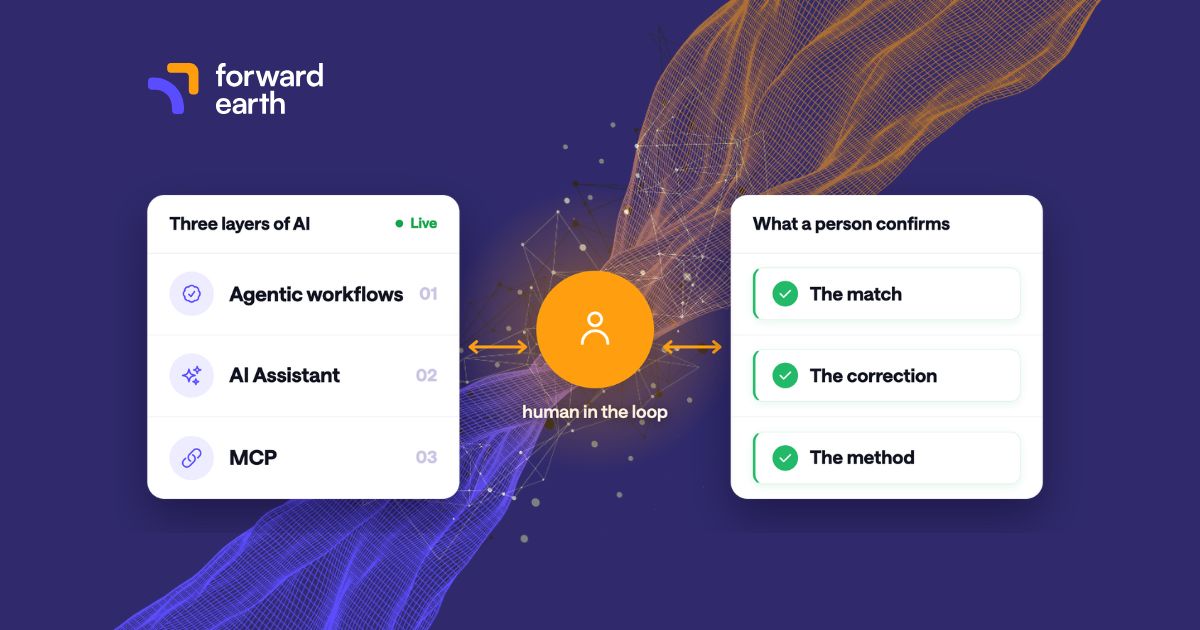
The review work stays yours, but you do not have to drive it by hand. The same workflow, from BoM upload to review, can run as a conversation with an AI agent, through two capabilities.
The PCF Assistant guides review in plain language. A conversational AI walks your team through review and refinement, with a human in the loop and every change auditable, so the people who own the data do not need to be LCA specialists.
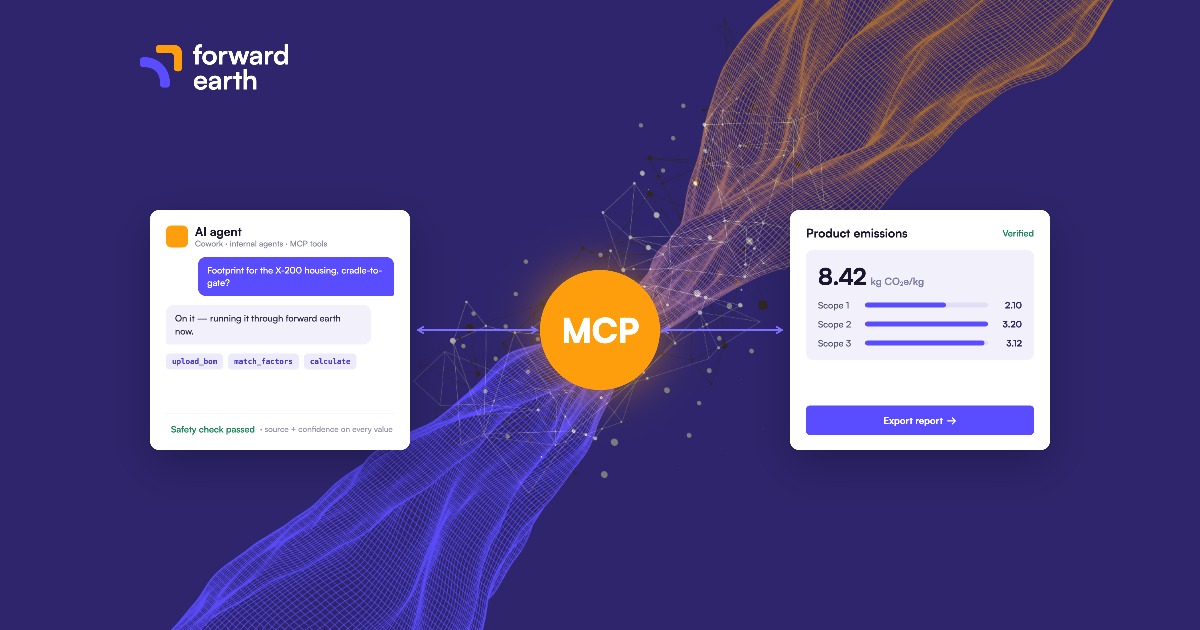
MCP brings the footprint to where your team already works. Our platform is available as an MCP (Model Context Protocol) server, so an AI agent, whether in Cowork or an internal agent you run, can upload a BoM, run a calculation, interpret results, model a scenario, and draft an ISO 14067 or PACT Pathfinder report. A skills layer encodes LCA expertise into each step: one skill validates the BoM before import, another documents methodology choices so they travel with the result, and a Result Safety Check independently validates a footprint before anyone sees it (mass coverage, order-of-magnitude plausibility, emission-factor provenance). That safety check is the difference between a defensible footprint and a confident-looking guess, and it is what low-cost AI estimators do not do.
Compliant is a claim buyers and regulators will test, so it is worth being exact about what it means.
ISO 14067 is the international standard for quantifying a product carbon footprint (ISO), and compliance means following its methodology and mandatory reporting fields, not showing a logo. Our assessments produce the full GWP indicator breakdown it expects (fossil, biogenic emissions and removals, direct land-use change, aircraft, and biogenic carbon content stored) and an ISO 14067-compliant Excel report covering its Section 7 fields, so a reviewer sees not just the number but how it was built.
We hold to the same discipline across the frameworks your buyers rely on. The GHG Protocol Product Standard (GHG Protocol) sets the underlying accounting principles, and PACT v3.0 (WBCSD) is the data model that lets a footprint travel from supplier to customer with its context intact. We are compliant with ISO 14067, PACT v3.0, and the GHG Protocol Product Standard, and aligned with the Catena-X PCF Rulebook v4.0, which builds on PACT Pathfinder (Catena-X).
That makes compliance a commercial asset rather than a bureaucratic hurdle: a transparent evidence package that shows how each number was built. From a finished assessment you get:
Formatted PDF and DOCX reports come from the MCP Report Draft skill. Today the scope is cradle-to-gate, the boundary most customer PCF requests and CBAM inputs use, and we keep moving toward full life-cycle assessment: more impact categories such as water, toxicity, and resource depletion, a cradle-to-grave scope, and EPD output.
A footprint is only useful if it drives a decision. Once your products are calculated, the results roll up into a portfolio you can manage, not just a compliance artefact you file away.
That turns a reporting obligation into a reduction roadmap, so the next PCF request is easier to answer than the last.
Consider a Tier 1 fabricated-metals supplier with roughly 600 active SKUs, most sharing a handful of base alloys and coatings. Two automotive customers have asked for PACT-format PCFs, and one product line is exposed to CBAM as an imported input.
Done manually, at even a few days of specialist time per product, that is a multi-year, six-figure project against a this-quarter deadline. Instead, the team exports the BoM, uploads all 600 products in one batch, and gets first results in about two minutes, with the full batch in less than 2 hours. The engine estimates and flags the missing weights on older SKUs and matches each alloy and coating line to a factor from its source database (e.g. ecoinvent), with a confidence score. The team spends its time where it counts: confirming the two alloys that drive most of the footprint, and swapping in a supplier-specific value for the coating where they have primary data. That shift matters: in an internal Catena-X case study, primary data instead of industry averages cut PCF values by 46 percent (Catena-X).
They export a PACT-compliant CSV for the customers and an ISO 14067 Excel report for internal sign-off and the CBAM input. Not perfect on day one, but a defensible baseline across the whole portfolio, on the customer's timeline, with a short list of what to improve next.
Direct manufacturers use the platform to clear their supplier-reporting bottleneck. B2B software providers and consultancies face a parallel pressure: GRC platforms, ERP vendors, and supply-chain software providers need to offer carbon metrics to keep clients who are scrambling to report product-level footprints. Rather than spending years building an engine, they can embed ours through our white-label solution and offer BoM-native footprint calculation to their existing users.
Embedding this lets partners move from static sustainability reporting to product-level analytics, adding carbon management to their offering with a fast time to market rather than a multi-year build.
Pulling it together, here is what you get and why it matters:
See the full picture of how it works on our Product Carbon Footprint page.
Your customers are already asking, the regulatory cost is already live, and the manual route does not scale to the deadline. The way through is one workflow that gives you the rigour of LCA and the speed of AI on the same result, straight from the BoM you already have. That holds whether you calculate footprints for your own portfolio or offer them to your customers through our white-label platform.
Book a PCF demo and bring a sample BoM, or request a BoM readiness walkthrough, and we will show you what your data can produce today and what to improve first.
Upload the BoM (materials, components, quantities, units, and weights where available). The AI-assisted engine estimates the gaps and matches each line item to an emission factor with a visible confidence score and rationale, you review the assumptions that matter, and you export a compliant result. No separate manual LCA per product.
Both follow the same underlying methodology, governed by ISO 14040 and ISO 14044. A full LCA measures 16 or more environmental impact categories, from water use to toxicity, and typically takes weeks to months per product. A PCF applies the same rigour to one category, greenhouse gas emissions, governed by ISO 14067. We break the distinction down in our guide to product-specific emissions: PCF, LCA, and CBAM. For customer requests, CBAM, and CSRD Scope 3, a PCF is what is being asked for, and our results are built to extend to full LCA later
You can start with imperfect data. Missing weights and energy are estimated, labelled, and returned for review, and accuracy improves as you confirm the high-impact assumptions and add supplier-specific data over time.
Results are compliant with ISO 14067:2018, PACT v3.0, and the GHG Protocol Product Standard, and aligned with the Catena-X PCF Rulebook v4.0. You can export an ISO 14067-compliant Excel report and a PACT-compliant CSV.
The CBAM definitive period started on 1 January 2026, so EU importers of covered goods now declare embedded emissions annually and surrender certificates against them, with the first declarations due by 30 September 2027 (European Commission). Accurate product-level data keeps that cost based on your real emissions rather than penalising default values, and an ISO 14067 report gives the declaration a documented basis. See how we handle the import side on our CBAM solution page.
First results in about two minutes, and a full batch of up to 1,000 products (up to 500,000 BoM rows per file) in less than two hours from upload.