How three layers of AI calculate an auditable carbon footprint
Micha Schildmann, Melina Hürzeler
|
September 25, 2026

Micha Schildmann, Melina Hürzeler
|
September 25, 2026
AI handles the jobs that consume most of the time in a footprint: harmonising messy source data, matching each line to an emission factor, and filling the gaps the data leaves.
Speed on its own is not enough. A number with no traceable basis cannot be checked by an auditor, reused by a customer, or signed by a verifier.
An automated footprint holds up when the reasoning is visible on every output, a person confirms before it counts, and the methodology choices travel with the result.
An OEM asks a Tier 1 supplier for product carbon footprints on 40 parts, inside an RFQ window. A customer questionnaire arrives with a data quality column next to every figure. A CBAM declaration, since the definitive regime began in 2026, carries a verification report from an accredited verifier (DEHSt). None of those three accepts a number nobody can explain.
Manual footprint work runs at weeks per product, and Scope 3 data still lives in scattered spreadsheets. The arithmetic does not close.
That is the gap AI closes, and it brings a second problem with it.
Not automatically, and the numbers are worth knowing. In a study in Environmental Science & Technology, an AI system built specifically to match emission factors was correct 86.9% of the time running fully automatically, and had the right factor somewhere in its top ten 93.1% of the time (Balaji et al., 2025). Those are strong numbers for automation. Read the other way, roughly one in eight fully automated recommendations was wrong, which is why ranked alternatives and a confirmation step matter more than a single confident answer.
This is what separates a carbon estimator from a calculation engine. A model asked to guess the footprint of an aluminium housing returns a plausible figure in a confident tone with no traceable basis. Nothing in that output tells a reviewer which emission factor produced it, how the boundary was drawn, or where the uncertainty sits. An auditor cannot check it, a customer cannot reuse it, and a CBAM verifier will not sign it.
An AI-calculated carbon footprint is a footprint where AI does the data work and the matching, while the methodology, the sources and the confirmation stay visible and attributable. The automation earns its place by showing what it did.
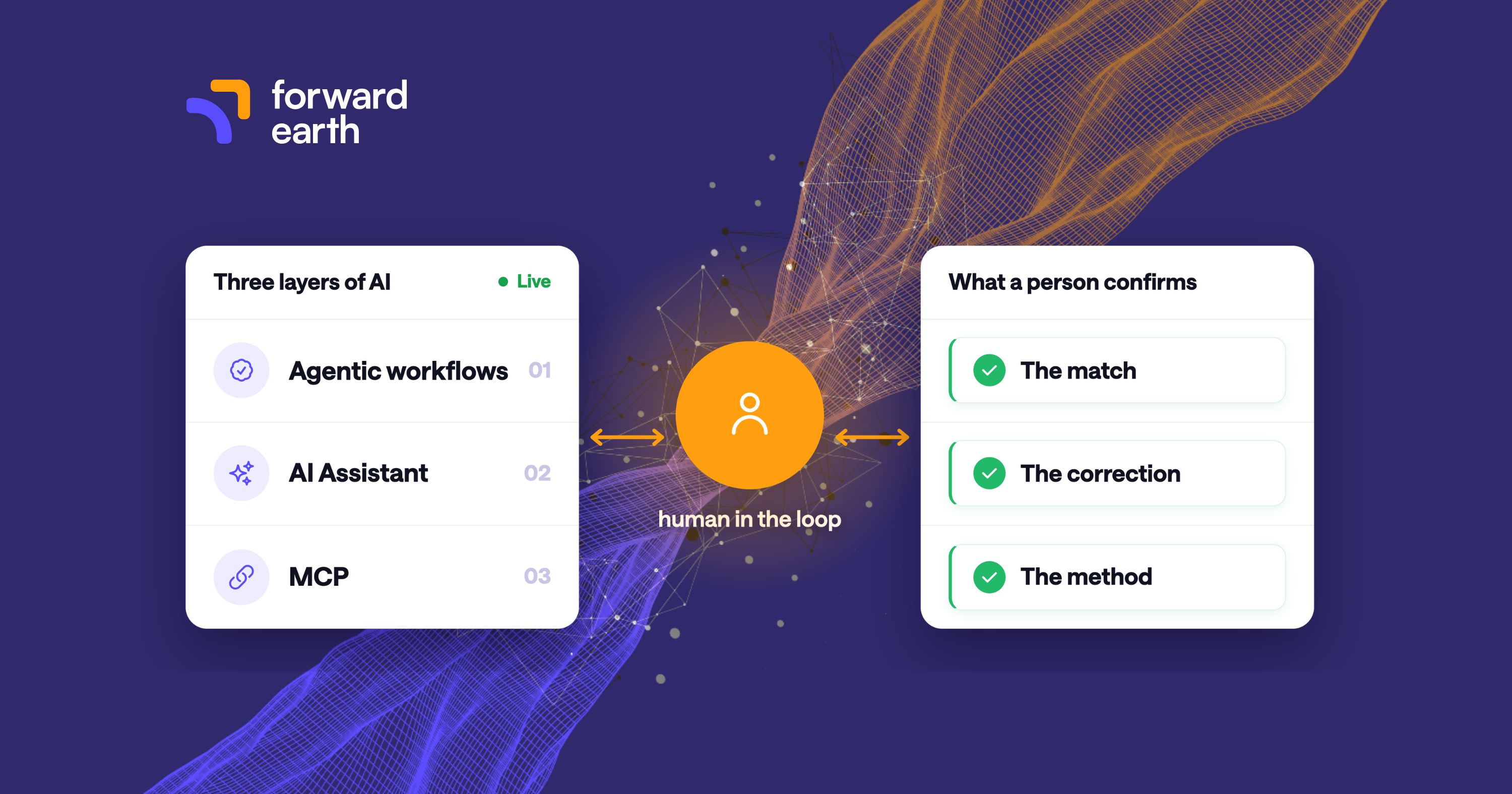
AI calculates a carbon footprint in three layers: agents prepare the data and match each line to an emission factor, a conversational layer puts the open gaps in front of a person, and an MCP runs it inside the tools a team already uses. Nothing counts until someone confirms it, which is what makes the result auditable.
Our approach splits the work across three layers, and the split is the point: each one solves a different failure mode.
The three layers matter together, which is the argument our AI capabilities overview sets out in full. Agents without a review layer produce volume nobody trusts. A conversational layer without agents gives you a pleasant way to discuss data you still have to prepare by hand. Both without distribution leave the footprint stranded in a tool the buyer does not open.
Take a machinery manufacturer with an ERP BoM export: non-standard columns, several hundred products, missing weights on assemblies, and no energy data below site level.
Batch ceilings: up to 1,000 products per batch and 500,000 BoM rows per file, with a full batch calculated in under two hours. A first result arrives in minutes.
Confirmation happens at three points. The agents put every match in front of a person with its confidence score, its rationale and ranked alternatives, and a low-confidence match counts for nothing until someone accepts or changes it. In the assistant, the person decides what to fix first from the ranked list, supplies the material context on a weak match, and approves the correction before it travels across identical items. Through the MCP, the methodology choices that shape the result (standard, allocation method, system boundary, cut-off rules) and every input the platform would otherwise default (energy assumptions, output units, the emission factor on hotspot materials) come back for confirmation or override, and those choices are written to the assessment so they travel with the result when an auditor or a customer asks how the number was built.
How accurate a footprint is depends on the quality of the input data, which emission factor each line was matched to, how emissions from a shared process were allocated between its outputs, and whether someone reviewed all three. Estimated values stay labelled and improve as better data arrives, and the primary data share is the metric that shows how far a footprint has moved from estimates towards supplier-specific data.
We compress the work and keep the judgement with the team. That is the shape of a footprint that holds up.
The footprint is a means to the next decision: answering the customer, choosing between two suppliers, judging whether a material change earns its cost. Hours not spent chasing a missing weight are hours available for that work.
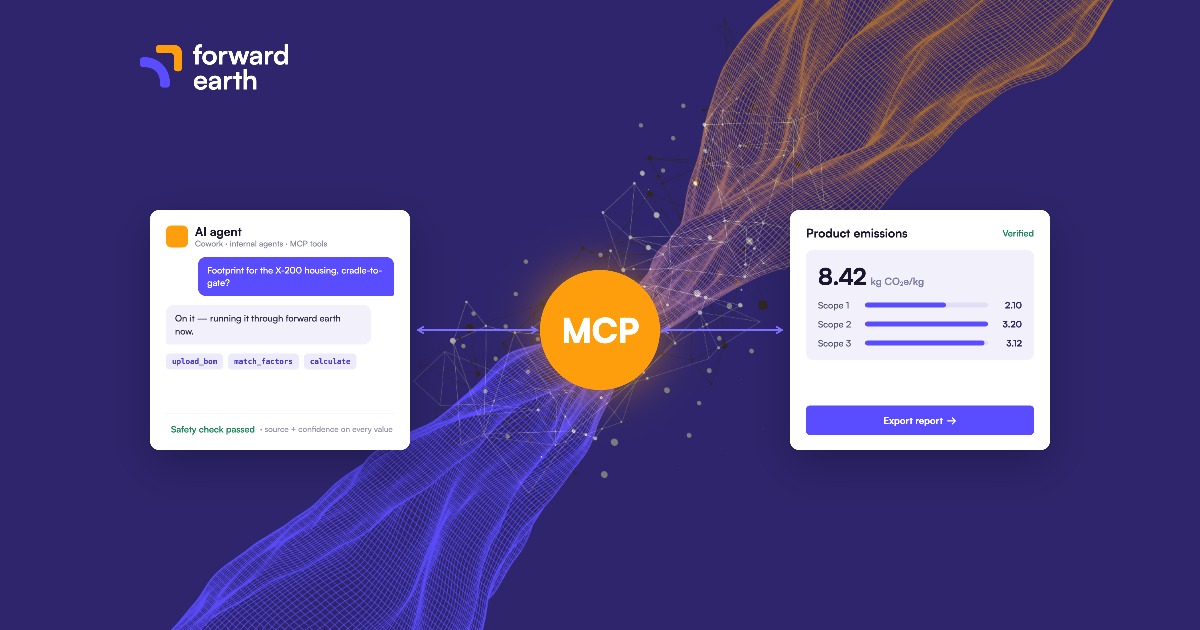
For software vendors, consultancies and service providers, the MCP resolves build versus buy without an integration project. Connect an existing agent or embed our MCP server, and carbon calculation becomes a capability of the platform your customers already run, safety check and per-value provenance included. Our MCP page covers the tool surface.
See how the three layers work together on our AI capabilities page.
Customers are already asking for carbon data, the regulatory deadlines are already set, and manual work does not keep up. Automation that shows its work is the only kind that survives a customer questionnaire, an internal audit and a verifier in the same year. That is what we built.
Book a demo and bring a sample of your own data. We will show you what it produces today and what to improve first.
Accuracy depends on input data quality, emission factor selection, allocation logic and review, not on the model alone. AI-assisted matching speeds up the work, and reviewers should still confirm the key assumptions. Estimated values stay labelled, so teams can see where confidence is low and replace those inputs first.
Yes. Manufacturers need enough structured data for a first calculation, not perfect data. The prediction agent models the processes and upstream networks the data does not describe, and missing values arrive later by chat or file upload.
Every match carries a confidence score, a rationale and a source, and the methodology choices are written to the assessment so they travel with the result. Our exports are compliant with ISO 14067:2018 and PACT v3.0.
No. The skills layer encodes what to ask and what to check at each step, which lowers how much specialist time a footprint consumes. Methodology choices, hotspot emission factors and boundary decisions stay with a person, because those are the inputs a reviewer will question.
For product footprints, most manufacturers work to ISO 14067:2018, PACT v3.0 or the GHG Protocol Product Standard, with the Catena-X PCF Rulebook v4.0 relevant in automotive supply chains. CBAM sits separately, with its own methodology and a verification requirement from 2026.
Yes. Our platform is available as an MCP server, so an existing agent can upload data, run calculations, search the emission factor database, model scenarios and generate report drafts. A safety check validates the result before it is shared.